
Succession Planning for Small Businesses
Succession Planning for Small Businesses (With Real Examples, Timeline & Step-by-Step Guide)
Alessandro Badalamenti
5/8/202618 min read


Succession Planning for Small Businesses (With Real Examples, Timeline & Step-by-Step Guide)
Most small business owners believe they have something valuable to sell.
In reality, many have built something that cannot survive without them.
That’s the gap.
And it explains why so many businesses never successfully transition.
Industry data consistently shows that only around 20–30% of small businesses listed for sale actually sell, often due to poor preparation, lack of systems, or excessive reliance on the owner. At the same time, millions of business owners are approaching retirement, creating one of the largest ownership transitions in decades.
This isn’t a future problem.
It’s already happening.
Succession planning is what separates businesses that:
sell at a premium
transition smoothly
or continue operating without disruption
from those that lose value,or never sell at all.
You can start with a structured business assessment: it is a 90-second digital check-up to understand your business’s visibility strength, and where you’re currently positioned
Navigate this guide below to explore each step of succession planning for small businesses and focus on the topics most relevant to your situation.
Understanding Succession Planning in Small Businesses
Why Business Succession Is Becoming Urgent
Why Many Small Businesses Fail to Transition Successfully
Measuring Owner Dependency: A Practical Framework
Choosing the Right Succession Path for Your Business
What Buyers Evaluate Before Acquiring a Business
Real-World Succession Plan Examples Across Industries
A Practical Roadmap to Prepare Your Business for Transition
How Long It Takes to Become Exit-Ready
A Practical Checklist to Assess Your Readiness
Common Pitfalls That Undermine Business Transitions
How Preparation Directly Impacts Business Valuation
Key Advantages of Being Fully Exit-Ready
Evaluating Whether Your Business Is Truly Transferable
Planning Your Exit: Final Considerations
Frequently Asked Questions About Small Business Succession
What Is Succession Planning for Small Businesses?
Succession planning is the process of preparing your business to operate without you.
That could mean:
selling it
transferring it
or stepping back from day-to-day involvement
It’s not just about identifying a successor.
It’s about making your business:
transferable
structured
and valuable
A proper succession planning for small businesses focuses on reducing risk for whoever takes over.
Because from a buyer’s perspective, value comes down to one thing:
How easily can this business run without the current owner?
Why Succession Planning Matters More Than Ever
We are in the middle of a major transition.
A large percentage of small businesses are owned by Baby Boomers
Millions of companies are expected to change hands in the next 10–15 years
Many are not prepared for that transition
This creates a market imbalance:
more businesses for sale
but fewer that are actually “sellable”
That’s where preparation becomes a competitive advantage.
Businesses that are structured, documented, and scalable stand out immediately.
For a deeper analysis of this trend, explore our insights on baby boomer business succession.
Why Most Small Businesses Are Not Ready to Sell
This is where most owners underestimate the problem.
A business can be profitable and still be unsellable.
Common issues include:
The owner is involved in every decision
No documented processes or systems
Financials are inconsistent or unclear
Customer relationships depend on the owner
No management layer
Revenue is unpredictable
In real projects across service businesses, SaaS, and hospitality, this pattern shows up consistently.
The issue is not demand.
It's a risk.
And risk reduces value,or kills deals entirely.
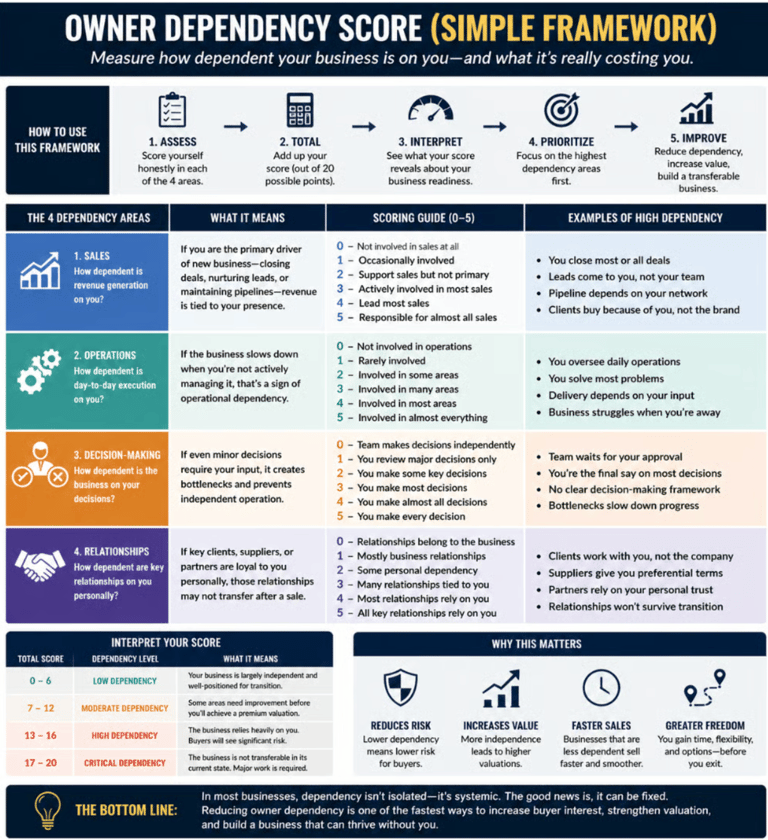
The Owner Dependency Score (a Simple Framework)
One of the fastest ways to understand how prepared your business is for a transition is to assess how dependent it is on you.
Instead of guessing, you can break this down into four key areas: sales, operations, decision-making, and relationships.
Start with sales. If you are the primary driver of new business,closing deals, nurturing leads, maintaining pipelines,then revenue is directly tied to your presence. A buyer will immediately see this as a risk.
Then look at operations. Are you involved in day-to-day delivery, problem-solving, or execution? If the business slows down when you’re not actively managing it, that’s a clear sign of operational dependency.
Decision-making is another major factor. In many small businesses, even minor decisions require the owner’s input. This creates bottlenecks and makes it difficult for the business to scale or function independently.
Finally, consider relationships. If key clients, suppliers, or partners are loyal to you personally rather than to the company, those relationships may not transfer after a sale.
When you look at these four areas together, a pattern usually emerges. In most cases, dependency isn’t isolated, it’s systemic. In transformation projects across service, SaaS, and hospitality businesses, reducing this dependency has consistently been one of the fastest ways to increase both buyer interest and overall valuation.
Not because revenue suddenly increases, but because the business becomes more stable, predictable, and transferable.
If you’ve gone through the dependency breakdown and recognize yourself in several of these points, the business is not yet in a sellable or transferable state.
That doesn’t mean it has low value, it means the value is still tied to you.
You can benchmark your current position with a structured business review.
The 3 Main Types of Business Succession Plans (and How to Choose the Right One)
When business owners start thinking about exit planning, they usually jump straight to valuation or “how much can I sell for.”
That’s the wrong starting point.
Before anything else, you need clarity on which succession path you’re actually building toward, because each one requires a completely different strategy, timeline, and level of preparation.
Here are 6 Methods for Valuing a Company that you should look into.
1. Selling the Business (External Exit Strategy)
This is the most common and most commercially driven option.
You sell to:
An individual buyer (entrepreneur or investor)
A strategic competitor (industry consolidation)
A private equity firm or financial investor
What matters here
If your goal is a sale, buyers don’t care about your effort or history. They care about:
Predictable profits (EBITDA stability)
Low owner dependency
Documented systems and processes
Customer concentration risk
Scalability
Reality check
This option usually requires the highest level of preparation.
Most businesses are not actually “sellable” at a good price until they fix operational dependencies on the owner.
SME and entrepreneurs are engines of resilience and growth, with their contributions varying largely across firms, sectors and places.
2. Transferring Ownership (Internal Succession)
This involves passing the business to people already inside or close to the company:
Family members (family business succession)
Employees (Management Buyout – MBO)
Business partners or co-founders
What matters here
Unlike selling, this is less about maximizing price and more about:
Continuity of operations
Cultural stability
Leadership transition
Financing structure (often vendor financing or staged buyouts)
Reality check
This is where many businesses fail, not because of lack of interest, but because:
the next generation is not ready
roles were never formalized
decision-making is still centralized in the founder
3. Scaling Before Exit (Value Optimization Strategy)
This is the most underestimated and often the most powerful path.
Instead of exiting immediately, you intentionally delay the exit to:
Increase profitability
Improve margins
Build systems and delegation layers
Reduce owner dependency
Professionalize reporting and operations
What this actually means
You are not just “growing the business.”
You are actively turning it into a more valuable asset that can be sold at a higher multiple.
Even small improvements in:
recurring revenue
customer diversification
operational delegation
can significantly increase valuation multiples.
Reality check
Many businesses that take 18–36 months to prepare properly see:
higher buyer interest
faster deal closing
significantly better valuation multiples
Because buyers don’t pay for potential,they pay for structure.
What Buyers Actually Look for in a Small Business
Buyers don’t evaluate a business the way owners do. Owners look at effort, history, and growth potential. Buyers look at risk, predictability, and transferability. If those three things are weak, everything else becomes secondary.
EBITDA stability
Buyers want earnings they can rely on, not spikes or inconsistencies.
Stable EBITDA means the business produces similar profit levels month after month, without extreme fluctuations caused by seasonality, one-off deals, or owner involvement. If profitability swings heavily, buyers assume the business is harder to control than it appears on paper, and they will discount the valuation accordingly.
Recurring revenue
Predictable income is one of the strongest value drivers in any small business.
Recurring revenue, such as retainers, subscriptions, or repeat contracts, reduces uncertainty. It tells a buyer that the business will continue generating cash flow even without aggressive sales activity. The higher the proportion of recurring revenue, the lower the perceived risk.
Low owner dependency
This is often the biggest deal-breaker.
If the owner is involved in sales, key client relationships, decision-making, or delivery, the business is not truly transferable. Buyers want a structure where operations continue normally without the founder present. The less the business depends on one person, the more it resembles an asset rather than a job.
Clean financials
Financial clarity is non-negotiable.
Buyers expect:
accurate profit and loss statements
clear separation of business and personal expenses
consistent categorisation of costs and revenue
reliable historical data
Messy or incomplete financials immediately increase perceived risk. In many cases, they don’t kill the deal outright, they just reduce the price significantly.
Documented systems
A business without systems is not scalable or transferable.
Documented processes across sales, operations, hiring, and delivery allow a buyer (or new operator) to step in without disruption. If knowledge exists only in the owner’s head, it has no transferable value.
Systems turn a business from something “dependent on people” into something that can operate independently.
Four Examples of a Succession Plan for a Small Business
Most succession planning advice stays theoretical. It talks about “systems” and “exit readiness” without showing what actually changes inside a business over time.
PwC’s 11th Global Family Business Survey, which includes a series of deep-dive articles and webcasts, explains how family businesses need to adopt new priorities to secure their legacy.
Below are four realistic examples showing how succession planning unfolds in practice, year by year. The point is not perfection,it’s progression from owner-dependent to transferable business.
Example 1: Succession Plan for a Service Business
Before
The business is almost entirely owner-driven.
The owner manages every key client relationship personally, which means revenue is highly fragile. Pricing is inconsistent, often negotiated case by case, and there is no real operational structure,just execution based on memory, experience, and relationships.
Year 1: Foundation & Structure
The first step is to remove chaos from delivery.
Document core services and delivery workflows
Standardize pricing and packaging
Start separating sales from delivery
Hire an account manager to absorb client communication
The goal here is not growth,it’s repeatability.
Year 2: Delegation & Revenue Stability
Once delivery is structured, focus shifts to reducing dependency on the founder.
Introduce recurring retainers instead of one-off projects
Shift client execution to the internal team
Owner steps back from day-to-day delivery
Begin building predictable monthly revenue streams
At this stage, the business starts to behave less like a freelance operation and more like a system.
Year 3: Optimization & Exit Readiness
Now the focus becomes financial and strategic cleanup.
Improve margin structure and cost visibility
Clean up financial reporting (P&L clarity, client profitability)
Reduce owner involvement to strategic oversight only
Prepare data room for potential buyers
After
The business is no longer dependent on one person.
Revenue is predictable, operations are delegated, and the business can be valued on earnings,not on the owner.
Example 2: Succession Plan for a Retail Business (Physical + Online)
Before
The owner is involved in everything: inventory, suppliers, pricing, and day-to-day store operations. The business works, but it is exposed,profitability fluctuates and nothing is systemized.
Year 1: Operational Control
The first improvement is tightening control over the core mechanics.
Implement proper inventory and stock management system
Renegotiate supplier terms to improve margins
Reduce stock inefficiencies and dead inventory
This stage is about stopping financial leakage.
Year 2: Channel Expansion & Team Building
Once operations stabilize, the business expands structurally.
Launch or scale e-commerce channel
Train and appoint a store manager
Start building repeat customer base (CRM, loyalty, email)
Now the business stops being purely location-dependent.
Year 3: Stabilization & Exit Preparation
The focus shifts from building to stabilizing.
Align online and offline revenue streams
Reduce owner involvement in daily operations
Document processes across procurement, sales, and fulfillment
Position the business for acquisition or partnership
After
The business becomes multi-channel, more resilient, and significantly more attractive to buyers because revenue is diversified and not tied to the owner or a single channel.
Example 3: Succession Plan for a SaaS Business
Before
The founder is the system. Sales, product decisions, and operations all flow through them. Reporting is limited, and growth is unpredictable.
Year 1: Metrics & Retention Focus
The first transformation is visibility.
Improve onboarding and user activation
Define core metrics: MRR, churn, LTV, CAC
Start tracking cohort behavior and retention
At this stage, the goal is clarity,not growth.
Year 2: Team & Predictability
Once metrics are in place, the focus shifts to scaling with structure.
Build a small management team (product, sales, support)
Introduce predictable acquisition channels
Reduce founder dependency in sales and product decisions
The business starts to become “operable without the founder in every loop.”
Year 3: Unit Economics & Exit Positioning
Now the business is optimized for valuation.
Improve unit economics (CAC payback, churn reduction)
Strengthen revenue predictability
Build acquisition-ready reporting and metrics dashboard
Begin conversations with potential acquirers
After
The company becomes a scalable asset with clean metrics, strong retention, and clear growth signals,exactly what buyers or investors pay premiums for.
Example 4: Succession Plan for a Family Business (Hospitality / Restaurant)
Before
The founder runs everything: operations, suppliers, staff management, and customer relationships. The business survives on presence, not systems.
Year 1: Documentation & First Delegation
The first step is creating structure where none exists.
Identify and train a potential successor
Document key operations (recipes, suppliers, staffing, service standards)
Start delegating daily tasks gradually
This is usually the most uncomfortable phase because control starts shifting.
Year 2: Operational Transfer
The successor begins to take real ownership.
Successor manages day-to-day operations
Founder shifts to advisory or oversight role
Staff begins reporting to new leadership
Financial responsibilities partially transferred
The business starts functioning without constant founder presence.
Year 3: Ownership Transition
This is the formal and final phase.
Full ownership transition completed (legal + operational)
Founder steps back fully or becomes minority advisor
Systems and culture stabilized under new leadership
After
The business continues operating without disruption. Relationships with staff, suppliers, and customers remain intact because transition was gradual,not sudden.
Step-by-Step Succession Planning Process
1. Define Your Exit Goal
Everything starts with clarity.
Before making any operational changes, you need to decide what you actually want. Are you aiming to sell the business to a third party? Pass it on to a family member? Transition it to your team? Or step back while keeping ownership?
Each path requires a different strategy.
For example, selling to an external buyer typically requires stronger financial structure, clearer reporting, and a higher degree of operational independence. A family transition, on the other hand, may focus more on leadership development and continuity.
Without a clear goal, it’s easy to make decisions that don’t align with your desired outcome. You might optimize for growth when you should be optimizing for stability,or vice versa.
Defining your exit goal early gives direction to everything that follows.
2. Assess Your Business
Once your objective is clear, the next step is an honest assessment of where your business stands today.
This is where many owners underestimate the gap.
You need to look at your business from the perspective of a buyer:
Are financials clear and consistent?
Are operations structured and documented?
Is there a team capable of running the business?
How dependent is the business on the owner?
In many cases, small inefficiencies that seem manageable internally become major concerns during a sale process.
This stage is not about judgment,it’s about visibility.
The clearer you are about your starting point, the easier it becomes to close the gap.
3. Fix Structural Weaknesses
This is where the real work happens.
Most businesses don’t need to be reinvented,they need to be structured.
That means:
documenting key processes so they can be replicated
introducing systems that reduce manual work and errors
stabilizing revenue through repeat business or contracts
clarifying roles and responsibilities within the team
In several real-world cases, these changes didn’t just prepare the business for sale,they improved profitability and efficiency almost immediately.
What you’re doing here is transforming the business from something that depends on effort into something that runs on systems.
4. Reduce Owner Dependency
This is one of the most critical,and often most difficult,steps.
Letting go of control is not just operational, it’s psychological.
But from a valuation perspective, it’s essential.
If you are the person closing deals, solving problems, managing clients, and making decisions, then the business cannot function without you. And that limits who can buy it,and how much they are willing to pay.
Reducing dependency means gradually shifting responsibilities to your team, building trust in their capabilities, and allowing the business to operate without constant intervention.
In practice, this often happens in stages. You don’t disappear overnight,you step back progressively while the business proves it can sustain itself.
5. Strengthen Financials
Financial clarity builds confidence.
Buyers don’t just look at revenue,they look at how predictable, transparent, and sustainable that revenue is.
This means:
having clean, well-organized financial statements
tracking profitability accurately
understanding key metrics like margins and cash flow
reducing unnecessary costs
In many situations, improving financial structure alone can significantly increase perceived value,not because the business is earning more, but because it is easier to understand and trust.
6. Build a Transition Plan
A successful transition doesn’t happen by accident.
You need a clear plan that outlines how ownership, responsibilities, and knowledge will be transferred.
This includes:
defining timelines
preparing documentation
communicating with key stakeholders
ensuring continuity for customers and employees
A well-structured transition plan reduces uncertainty and makes the process smoother for everyone involved.
7. Execute Gradually
The biggest mistake owners make is trying to rush the process.
Strong transitions are built over time.
By implementing changes gradually, you allow:
systems to stabilize
teams to adapt
performance to remain consistent
This not only improves the outcome but also gives you more control over the timing and terms of your exit.
How Long Does Succession Planning Take?
Time is one of the most underestimated factors.
Less than a year often leads to rushed decisions and lower outcomes.
One to three years can produce solid results.
Three to five years is where the strongest outcomes typically happen.
Across multiple industries, the biggest gains have come from consistent, gradual improvements,not last-minute fixes.
Looking at getting help with this? Email us at hello@yourtmg.com and we’d be happy to offer a 45 min free consultation for you
Succession Planning Checklist for Small Businesses
This checklist is not about theory or “best practice.” It’s a reality check on whether your business is actually transferable, or whether it’s still built around you.
If you’re honest with these answers, you’ll know exactly where you stand.
1. Can the business run without you?
This is the most important test.
If you disappeared for 30–60 days, would the business continue operating normally—or would things slow down, break, or stop?
Look at this across three areas:
Sales: Are deals still closing without you involved?
Operations: Does delivery continue without your input?
Decisions: Does the team know what to do without asking you?
If your presence is required for the business to function, it is not yet transferable. It is still an extension of you.
2. Are your processes documented?
Most small businesses run on memory, habits, and verbal knowledge. That works—until someone else needs to take over.
Ask yourself:
Is your sales process written down step by step?
Are delivery and service workflows documented?
Can someone new replicate what you do without you explaining it live?
If the answer is no, then what you’ve built cannot scale or transfer reliably.
Documentation is what turns knowledge into an asset.
3. Do you have predictable revenue?
Buyers don’t pay for “good months.” They pay for stability.
Unpredictable revenue usually looks like:
one-off projects
inconsistent client acquisition
heavy reliance on referrals or personal selling
Predictable revenue looks like:
retainers or subscriptions
recurring contracts
repeat customers with known behaviour patterns
Without predictability, valuation drops sharply because risk goes up.
4. Are your financials clear and consistent?
If your financial data is messy, incomplete, or difficult to interpret, you don’t have a business that can be properly evaluated.
At minimum:
monthly profit and loss should be clean
revenue and costs should be categorised properly
margins per service or product should be known
cash flow should be trackable
If you cannot explain your numbers quickly and clearly, a buyer will assume risk—and discount the price.
5. Do you have a management layer?
A business without middle management is not a business—it is a job with employees underneath it.
A proper structure means:
someone else manages daily operations
decisions don’t all escalate to you
team members have clear ownership of functions
If every issue still comes back to you, then scaling or exiting is structurally blocked.
6. Are customer relationships tied to the business—not you?
This is one of the most underestimated risks.
Ask:
Do clients work with the company, or with you personally?
If you left, would they stay?
Are relationships shared across the team or locked in your head?
If clients are loyal to you rather than the business, then value is not transferable. It walks out the door when you do.
7. Do you know your valuation?
Most owners have a vague idea of what their business is worth—but no real basis for it.
A proper valuation should be grounded in:
EBITDA or profit multiples
industry benchmarks
quality of revenue (recurring vs one-off)
level of risk and dependency
If you don’t know your number—or how it’s calculated—you’re operating without a reference point for exit planning.
Final reality check
If several of these answers are “no,” the conclusion is simple:
Your business is not yet ready for succession.
That doesn’t mean it has no value. It means the value is still locked inside you, rather than embedded in the business itself.
Succession planning is the process of reversing that.
Common Mistakes to Avoid
Waiting too long
Most owners start thinking about succession when they’re already tired, burned out, or ready to exit immediately. That timing usually forces rushed decisions, weaker negotiation power, and fewer options. The best exits are built while the business is still performing well, not when pressure is already high.
Overestimating value
It’s common to assume that revenue or personal effort translates directly into valuation. Buyers don’t see it that way. They discount anything that feels unstable, dependent on the owner, or difficult to replicate. Emotional value rarely matches market value.
Ignoring operational weaknesses
Small inefficiencies that feel manageable internally often become major red flags during due diligence. Lack of documentation, inconsistent processes, or unclear responsibilities all reduce trust and increase perceived risk for buyers.
Not preparing the team
If the team is not gradually trained to operate without the owner, the transition becomes fragile. A business that depends on one person for direction, decisions, or client handling is not structurally ready for succession.
Letting emotions drive decisions
Succession is both a financial and psychological process. Owners often delay, over-control, or reject reasonable offers because of emotional attachment. That usually leads to missed opportunities or poorly timed exits.
This is where many deals fall apart—not because the business has no value, but because it was never prepared to be transferred in a clean, structured way.
The Financial Impact of Preparation
The Benefits of Being Succession-Ready
This is what nobody would tell you. Preparation directly affects value.
Buyers pay more for:
predictability
structure
low risk
In real-world cases across service, SaaS, and hospitality businesses, improvements like:
recurring revenue
documented systems
reduced owner involvement
have led to 20–50% higher valuation ranges, even without major revenue increases.
So you will simply get:
Higher valuation
Faster sale
Smoother transition
Stronger internal operations
Better employee retention
And most importantly, control over your exit.
Is Your Business Actually Sellable? Is your business actually ready?
Most owners assume that if their business is profitable, it’s sellable.
That’s not how buyers think.
A buyer isn’t just purchasing revenue,they’re buying a system that needs to continue working after the current owner is gone. The moment a business depends too heavily on one person, it becomes risky. And risk reduces value.
A simple way to think about this is to imagine stepping away from your business for 30 to 60 days. Would operations continue smoothly? Would clients stay? Would revenue remain stable?
If the answer is no, then the business isn’t truly sellable yet,it’s still dependent on you.
Across many small businesses, the same pattern shows up repeatedly. The owner is deeply involved in sales, manages key relationships, makes most decisions, and often holds critical knowledge that hasn’t been documented anywhere. From the outside, the business may look successful. From a buyer’s perspective, it looks fragile.
This doesn’t mean your business has no value. It means the value is tied to you personally rather than to the business itself.
The goal of succession planning is to shift that value away from the owner and into the business.
But honestly speaking, most owners don’t have a clear answer.
Start with a structured assessment.
You can run a free business audit to evaluate:
visibility
scalability
readiness
You can also explore real transformations through success stories to see how businesses improved their structure, operations, and exit readiness.
Final Thoughts: Your Exit Is Built Long Before You Leave
Succession planning is not about leaving your business.
It’s about making sure it survives,and thrives,without you.
Whether you sell, transfer, or scale, the outcome depends on preparation.
Not timing.
Not luck.
Preparation.
Most business owners wait too long.
The few who don’t are the ones who:
sell faster
sell for more
and leave on their own terms
Looking at getting help with this? Email us at hello@yourtmg.com and we’d be happy to offer a 45 min free consultation for you
FAQs: Succession Planning for Small Businesses
What is succession planning in a small business?
Succession planning is the structured process of preparing your business to operate and grow without you. It involves building systems, documenting operations, strengthening financials, and ensuring the business can be transferred or sold without disruption.
What is an example of a succession plan for a small business?
A typical example is a 3–5 year transition where the owner gradually steps back while improving structure and value. This includes documenting processes, building a team, introducing predictable revenue, and preparing the business for sale or transfer.
How early should I start succession planning?
Ideally 3–5 years before your intended exit. Businesses that start earlier tend to achieve better valuation outcomes and smoother transitions.
Can I sell my business without a succession plan?
Yes,but often at a lower valuation and with higher risk. Many businesses struggle to sell due to lack of preparation, unclear financials, or owner dependency.
What increases business value before selling?
Clear financials, predictable revenue, strong systems, and reduced reliance on the owner all increase buyer confidence and valuation.
How do I know if my business depends too much on me?
If operations slow down or decisions stop when you step away, the business is still owner-dependent.
What are the biggest risks of not planning succession?
Lower valuation, failed sale, operational disruption, and loss of key employees.
What is the difference between succession planning and an exit strategy?
An exit strategy defines how you leave. Succession planning prepares the business so that exit can actually happen successfully.
How much does succession planning cost?
The cost of succession planning varies significantly depending on the size and complexity of the business, but it is usually less expensive than not doing it.
For small businesses, costs typically fall into three categories:
Internal time investment: documenting processes, restructuring operations, and training staff (often the largest hidden cost)
Professional advisory support: accountants, lawyers, or M&A advisors if preparing for sale or transfer
Systems and tooling: accounting systems, CRM platforms, and operational software improvements
In practice, many businesses complete basic succession preparation with internal resources, while more advanced exit preparation (especially for a sale) may involve external advisory costs. The key point is that the cost of preparation is usually outweighed by the increase in valuation and smoother transition outcomes.
What is the best exit strategy for a small business?
There is no single “best” exit strategy—it depends entirely on the structure of the business and the owner’s priorities.
In general, there are three main options:
Selling to a third party
Usually the best option for maximizing financial return, especially if the business has strong systems, recurring revenue, and low owner dependency.Internal succession (family or management buyout)
Often chosen for continuity. It prioritizes stability and legacy over maximum valuation, but requires careful planning to ensure leadership readiness and financial feasibility.Gradual scaling before exit
This is often the most underestimated strategy. By improving profitability, reducing risk, and strengthening systems before selling or transferring, owners can significantly increase valuation and attract better buyers.
The most effective strategy is usually the one that aligns three things: business structure, timeline, and how dependent the business currently is on the owner.
Stay connected
The Makeover Group
Via di Belvedere 17, 50125,
Florence, Italy
© 2025. All rights reserved.